
Alex Ouyang | Abdul Latif Jameel Clinic for Machine Learning in Health
August 22, 2022
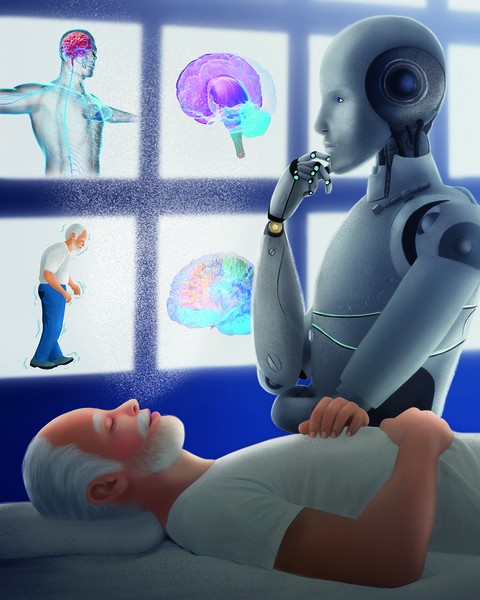
Parkinson’s disease is notoriously difficult to diagnose as it relies primarily on the appearance of motor symptoms such as tremors, stiffness, and slowness, but these symptoms often appear several years after the disease onset. Now, Dina Katabi, the Thuan (1990) and Nicole Pham Professor in the Department of Electrical Engineering and Computer Science (EECS) at MIT and principal investigator at MIT Jameel Clinic, and her team have developed an artificial intelligence model that can detect Parkinson’s just from reading a person’s breathing patterns.
The tool in question is a neural network, a series of connected algorithms that mimic the way a human brain works, capable of assessing whether someone has Parkinson’s from their nocturnal breathing — i.e., breathing patterns that occur while sleeping. The neural network, which was trained by MIT PhD student Yuzhe Yang and postdoc Yuan Yuan, is also able to discern the severity of someone’s Parkinson’s disease and track the progression of their disease over time.
Complete article from MIT News.
Explore
New Method Could Increase LLM Training Efficiency
Adam Zewe | MIT News
By leveraging idle computing time, researchers can double the speed of model training while preserving accuracy.

New Tool Makes Generative AI Models More Likely to Create Breakthrough Materials
Zach Winn | MIT News
With SCIGEN, researchers can steer AI models to create materials with exotic properties for applications like quantum computing.
New Imaging Technique Reconstructs the Shapes of Hidden Objects
Adam Zewe | MIT News
By leveraging reflections from wireless signals like Wi-Fi, the system could allow robots to find and manipulate items that are blocked from view