
Adam Zewe | MIT News Office
October 20, 2022
Ask a smart home device for the weather forecast, and it takes several seconds for the device to respond. One reason this latency occurs is because connected devices don’t have enough memory or power to store and run the enormous machine-learning models needed for the device to understand what a user is asking of it. The model is stored in a data center that may be hundreds of miles away, where the answer is computed and sent to the device.
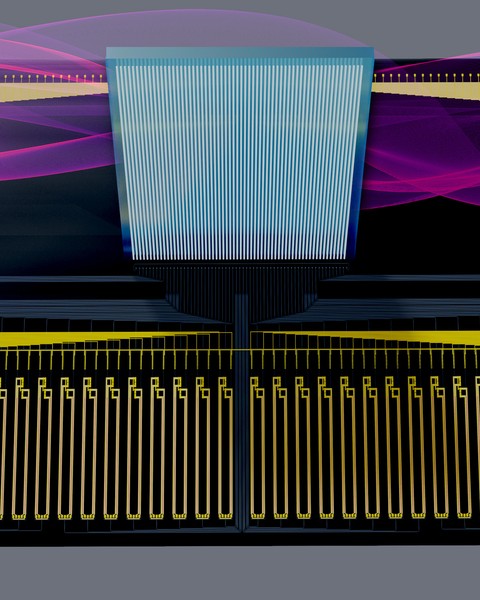
MIT researchers have created a new method for computing directly on these devices, which drastically reduces this latency. Their technique shifts the memory-intensive steps of running a machine-learning model to a central server where components of the model are encoded onto light waves.
Complete article from MIT News.
Explore
Discovering the Joy of Future-forward Electrical Engineering
Jane Halpern | Department of Electrical Engineering and Computer Science
One year in, MIT’s hands-on 6-5 (Electrical Engineering With Computing) degree program is already one of the most popular majors among first-year students.
New Photonic Device Efficiently Beams Light into Free Space
Adam Zewe | MIT News
Light-emitting structures that curl off the chip surface could enable advanced displays, high-speed optical communications, and larger-scale quantum computers.
New Method Could Increase LLM Training Efficiency
Adam Zewe | MIT News
By leveraging idle computing time, researchers can double the speed of model training while preserving accuracy.