
April 30, 2025
In the future, quantum computers could rapidly simulate new materials or help scientists develop faster machine-learning models, opening the door to many new possibilities.
But these applications will only be possible if quantum computers can perform operations extremely quickly, so scientists can make measurements and perform corrections before compounding error rates reduce their accuracy and reliability.
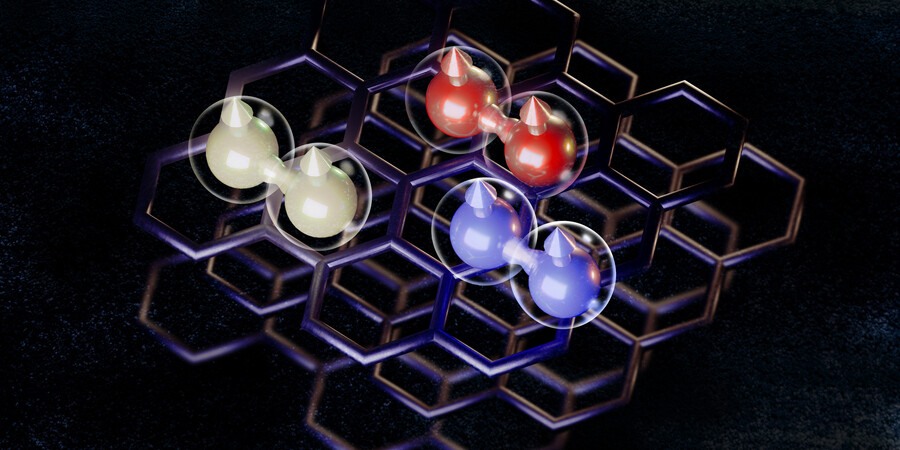
The efficiency of this measurement process, known as readout, relies on the strength of the coupling between photons, which are particles of light that carry quantum information, and artificial atoms, units of matter that are often used to store information in a quantum computer.
Now, MIT researchers have demonstrated what they believe is the strongest nonlinear light-matter coupling ever achieved in a quantum system. Their experiment is a step toward realizing quantum operations and readout that could be performed in a few nanoseconds.
Complete article from MIT News.
Explore
Tomás Palacios appointed Director of ISN
Office of the Vice President for Research
As director, Tomás will lead ISN’s research mission and build communities within MIT and with external partners.
MIT Engineers Design Structures that Compute with Heat
Adam Zewe | MIT News
By leveraging excess heat instead of electricity, microscopic silicon structures could enable more energy-efficient thermal sensing and signal processing.
Efficient cooling method could enable chip-based trapped-ion quantum computers
Adam Zewe | MIT News
New technique could improve the scalability of trapped-ion quantum computers, an essential step toward making them practically useful.