
Adam Zewe | MIT News Office
Every piece of data that travels over the internet — from paragraphs in an email to 3D graphics in a virtual reality environment — can be altered by the noise it encounters along the way, such as electromagnetic interference from a microwave or Bluetooth device. The data are coded so that when they arrive at their destination, a decoding algorithm can undo the negative effects of that noise and retrieve the original data.
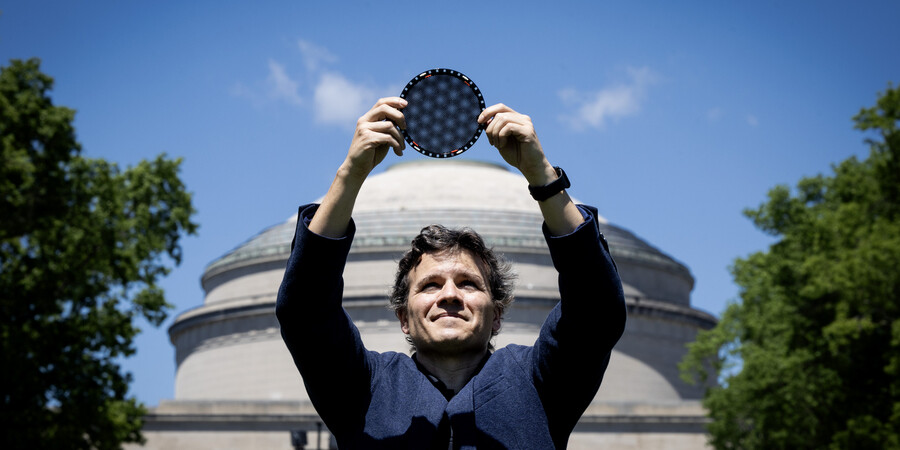
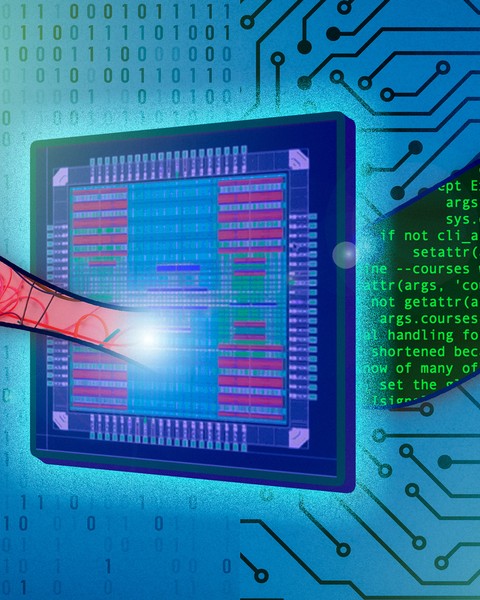
Researchers at MIT, including AI Hardware principal investigator Muriel Médard, Boston University, and Maynooth University in Ireland have now created the first silicon chip that is able to decode any code, regardless of its structure, with maximum accuracy, using a universal decoding algorithm called Guessing Random Additive Noise Decoding (GRAND). By eliminating the need for multiple, computationally complex decoders, GRAND enables increased efficiency that could have applications in augmented and virtual reality, gaming, 5G networks, and connected devices that rely on processing a high volume of data with minimal delay.
Complete article from MIT News.
Explore
Discovering the Joy of Future-forward Electrical Engineering
Jane Halpern | Department of Electrical Engineering and Computer Science
One year in, MIT’s hands-on 6-5 (Electrical Engineering With Computing) degree program is already one of the most popular majors among first-year students.
Tomás Palacios appointed Director of ISN
Office of the Vice President for Research
As director, Tomás will lead ISN’s research mission and build communities within MIT and with external partners.
Lisa Su ’90, SM ’91, PhD ’94 to deliver MIT’s 2026 Commencement address
Kathy Wren | MIT News
An electrical engineer by training, Su is the chair and CEO of the semiconductor company AMD.