


Jennifer Chu | MIT News Office
August 18, 2022
Wearable sensors are ubiquitous thanks to wireless technology that enables a person’s glucose concentrations, blood pressure, heart rate, and activity levels to be transmitted seamlessly from sensor to smartphone for further analysis.
Most wireless sensors today communicate via embedded Bluetooth chips that are themselves powered by small batteries. But these conventional chips and power sources will likely be too bulky for next-generation sensors, which are taking on smaller, thinner, more flexible forms.
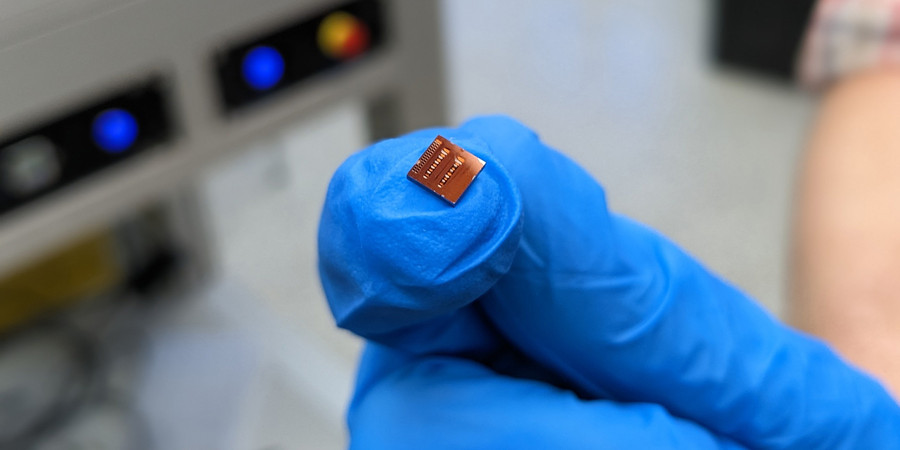
Now MIT engineers have devised a new kind of wearable sensor that communicates wirelessly without requiring onboard chips or batteries.
Complete article from MIT News.
Explore
New chip could help tiny robots traverse complex environments
Adam Zewe | MIT News
Researchers combined an efficient algorithm with dedicated hardware to rapidly generate 3D maps for navigation using minimal memory and power.

New Imaging Technique Reconstructs the Shapes of Hidden Objects
Adam Zewe | MIT News
By leveraging reflections from wireless signals like Wi-Fi, the system could allow robots to find and manipulate items that are blocked from view
Bringing Lab Testing to the Home
Zach Winn | MIT News
The startup SiPhox, founded by two former MIT researchers, has developed an integrated photonic chip for high-quality, home-based blood testing.


