March 10, 2023
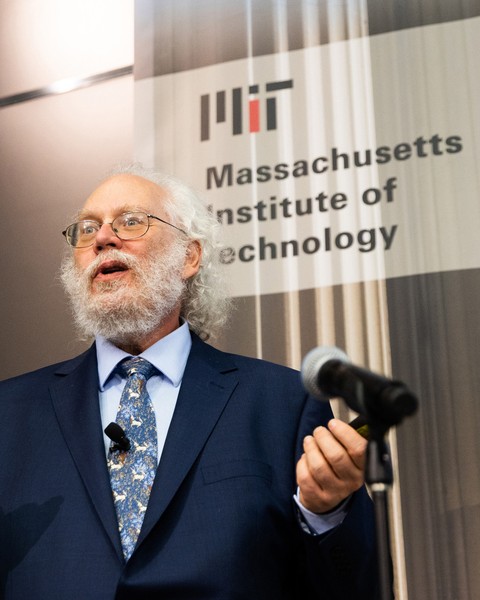
In 1994, as Professor Peter Shor PhD ’85 tells it, internal seminars at AT&T Bell Labs were lively affairs. The audience of physicists was an active and inquisitive bunch, often pelting speakers with questions throughout their talks. Shor, who worked at Bell Labs at the time, remembers several occasions when a speaker couldn’t get past their third slide, as they attempted to address a rapid line of questioning before their time was up.
That year, when Shor took his turn to present an algorithm he had recently worked out, the physicists paid keen attention to Shor’s entire talk — and then some.
“Mine went pretty well,” he told an MIT audience yesterday.
In that 1994 seminar talk, Shor presented a proof that showed how a quantum system could be applied to solve a particular problem more quickly than a classical computer. That problem, known as the discrete logarithm problem, was known to be unsolvable by classical means. As such, discrete logarithms had been used as the basis for a handful of security systems at the time.
Shor’s work was the first to show that a quantum computer could solve a real, practical problem. His talk set the seminar abuzz, and the news spread, then became conflated. Four days after his initial talk, physicists across the country were assuming Shor had solved a related, though much thornier problem: prime factorization — the challenge of finding a very large number’s two prime factors. Though some security systems employ discrete logarithms, most encryption schemes today are based on prime factorization and the assumption that it is impossible to crack.
“It was like the children’s game of ‘telephone,’ where the rumor spread that I had figured out factoring,” Shor says. “And in the four days since [the talk], I had!”
Complete article from MIT News.
Explore
Efficient cooling method could enable chip-based trapped-ion quantum computers
Adam Zewe | MIT News
New technique could improve the scalability of trapped-ion quantum computers, an essential step toward making them practically useful.
Lisa Su ’90, SM ’91, PhD ’94 to deliver MIT’s 2026 Commencement address
Kathy Wren | MIT News
An electrical engineer by training, Su is the chair and CEO of the semiconductor company AMD.
Theory-Guided Strategy Expands the Scope of Measurable Quantum Interactions
Adam Zewe | MIT News
An oft-ignored effect can be used to probe an important property of semiconductors, a new study finds.