
Friday, May 6, 2022 | 9:30am – 3:00pm ET
Multiple Speakers
The MIT AI Hardware Program is a new academia and industry collaboration aimed at defining and developing translational technologies in hardware and software for the AI and quantum age. A collaboration between the MIT School of Engineering and MIT Schwarzman College of Computing, involving the Microsystems Technologies Laboratories and programs and units in the college, the cross-disciplinary effort aims to innovate technologies that will deliver enhanced energy efficiency systems for cloud and edge computing.
Join us for its inaugural symposium on Friday, May 6th, 2022 at MIT, Building 46 Singleton Auditorium and Atrium.
Limited registration for the MIT community and corporate members only.
For detailed area hotel and MIT campus visit information, please go to Visit MIT
AGENDA
| Time | Event |
| 9:30 – 10:00 | Registration and Breakfast |
| 10:00 – 10:15 | Introduction to the MIT AI Hardware Program Jesus del Alamo & Aude Oliva – Program Co-Leads |
| 10:15 – 10:30 | Welcome Anantha Chandrakasan – Dean of Engineering, and Vannevar Bush Professor, Department of Electrical Engineering and Computer ScienceDaniel Huttenlocher – Dean of the Schwarzman College, and Henry Ellis Warren (1894) Professor, Department of Electrical Engineering and Computer ScienceHae-Seung ‘Harry’ Lee – Director of Microsystems Technology Laboratories, and Professor, Department of Electrical Engineering and Computer Science |
| 10:30 – 11:00 | Keynote – Brain Guided Intelligence Hardware Bilge Yildiz – Professor, Department of Nuclear Science and Engineering, and Professor, Department of Materials Science and EngineeringThis research looks at electrochemical synapses as building blocks to emulate and advance learning models. What can we learn from biological synapses to build better, more energy-efficient engineered hardware? Science research goals include modeling the circuits that both underlie complex learned behaviors and begin to emulate and advance state of the art learning rules. Engineering goals include building bio-inspired energy efficient hardware, new computing architectures, neural networks, and integrated high-density circuits. |
| 11:00 – 11:10 | Break |
| 11:10 – 12:30 | Lightning Talks: Selected Projects
Modern silicon photonics opens new possibilities for high-performance quantum information processing, such as quantum simulation and high-speed quantum cryptography.
This project pursues an integrated framework that includes energy-modeling and performance evaluation tools to systematically explore and estimate the energy-efficiency and performance of Analog Neural Network architectures with full consideration of the electrical characteristics of the synaptic elements and interface circuits.
This project pursues efficient machine learning for mobile devices where hardware resources and energy budgets are very limited.
This research project investigates a new ferroelectric synapse technology based on metal oxides that is designed to be fully back-end CMOS compatible and promises operation with great energy efficiency. |
| 12:30 – 3:00 | Lunch and Poster Session The session will feature up to 40 posters on the state of the art MIT research on energy efficient systems and devices, computing at the edge and new hardware technologies. Please note that the poster session will not be available via zoom. Featured Posters (list in progress)
|
Explore

MIT researchers advance toward greater bandwidth, more energy-efficient communications
Elizabeth A. Thomson | Materials Research Laboratory
The FUTUR-IC research program integrates electronics and photonics in microchip systems.
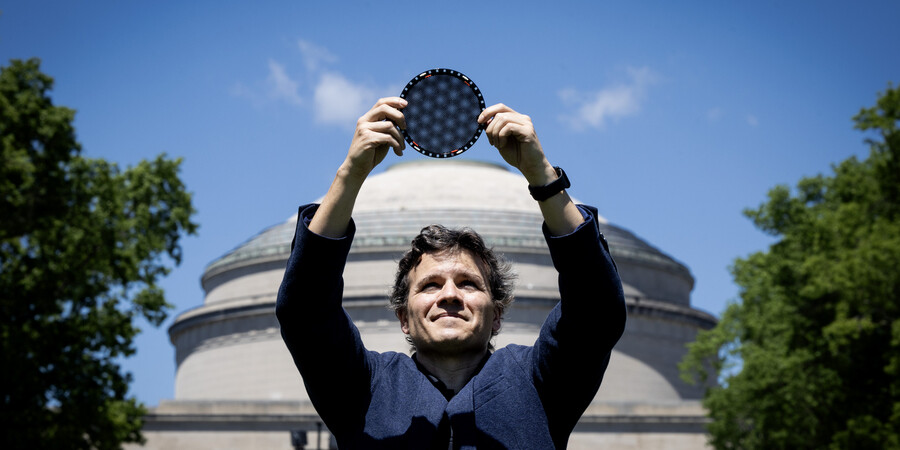
Pablo Jarillo-Herrero wins Kavli Prize in Nanoscience
Julia C. Keller | School of Science
The MIT physicist shares the honor with two others for foundational research establishing the field of twistronics.
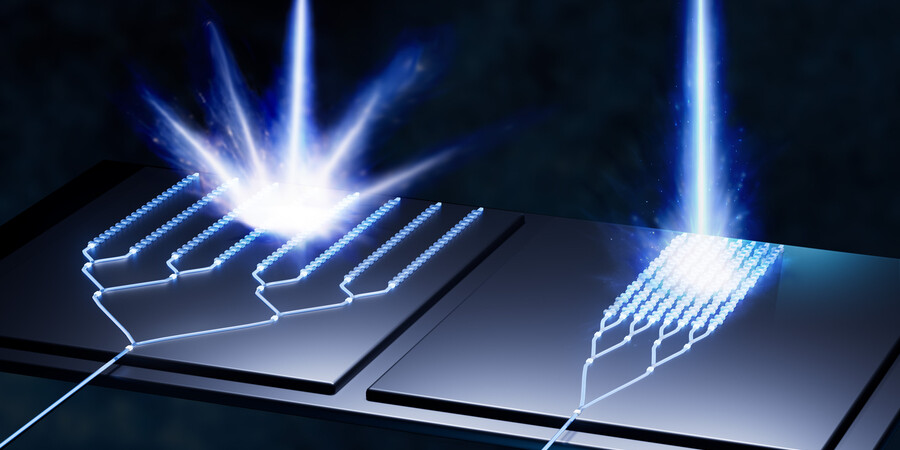
Photonics advance could enable compact, high-performance lidar sensors
Adam Zewe | MIT News
With a novel design, MIT researchers overcame a stubborn problem that has limited the effectiveness of chip-based systems for lidar.