January 29, 2026
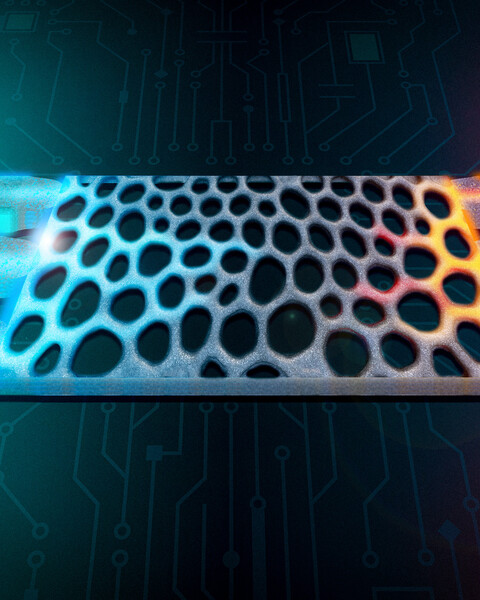
MIT researchers have designed silicon structures that can perform calculations in an electronic device using excess heat instead of electricity. These tiny structures could someday enable more energy-efficient computation.
In this computing method, input data are encoded as a set of temperatures using the waste heat already present in a device. The flow and distribution of heat through a specially designed material forms the basis of the calculation. Then the output is represented by the power collected at the other end, which is thermostat at a fixed temperature.
The researchers used these structures to perform matrix vector multiplication with more than 99 percent accuracy. Matrix multiplication is the fundamental mathematical technique machine-learning models like LLMs utilize to process information and make predictions.
Complete article from MIT News.
Explore
Electrons in Moiré Crystals Explore Higher-dimensional Quantum Worlds
Department of Physics
MIT physicists have discovered 3D “moiré crystals” that simulate four-dimensional quantum materials to a T.
MIT Researchers use AI to Uncover Atomic Defects in Materials
Zach Winn | MIT News
A new model measures defects that can be leveraged to improve materials’ mechanical strength, heat transfer, and energy-conversion efficiency.
“Near-misses” in Particle Accelerators can Illuminate New Physics, Study finds
Jennifer Chu | MIT News
Physicists discovered new properties of the strong force by analyzing what happens when light-speed particles skim by each other.