
Adam Zewe | MIT News Office
November 28, 2022
In a scene from “Star Wars: Episode IV — A New Hope,” R2D2 projects a three-dimensional hologram of Princess Leia making a desperate plea for help. That scene, filmed more than 45 years ago, involved a bit of movie magic — even today, we don’t have the technology to create such realistic and dynamic holograms.
Generating a freestanding 3D hologram would require extremely precise and fast control of light beyond the capabilities of existing technologies, which are based on liquid crystals or micromirrors.
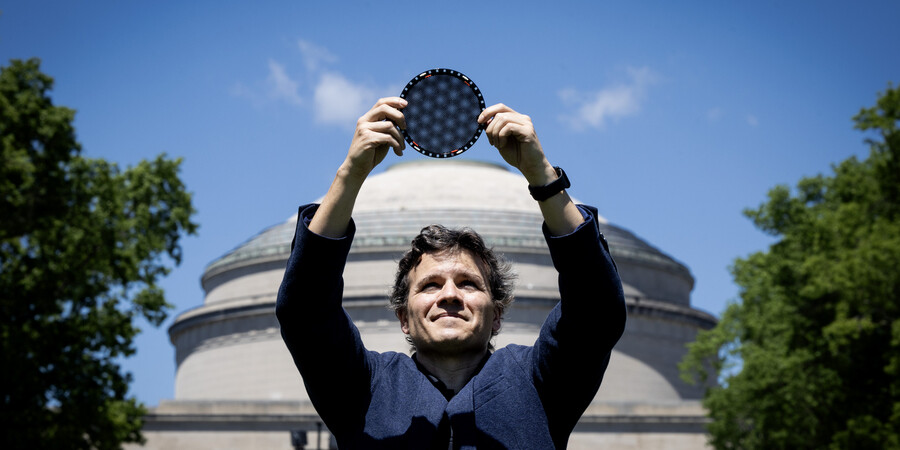
An international group of researchers, led by a team at MIT, spent more than four years tackling this problem of high-speed optical beam forming. They have now demonstrated a programmable, wireless device that can control light, such as by focusing a beam in a specific direction or manipulating the light’s intensity, and do it orders of magnitude more quickly than commercial devices.
Complete article from MIT News.
Explore
Lisa Su ’90, SM ’91, PhD ’94 to deliver MIT’s 2026 Commencement address
Kathy Wren | MIT News
An electrical engineer by training, Su is the chair and CEO of the semiconductor company AMD.
New 3D Chips could Make Electronics Faster and more Energy-Efficient
Adam Zewe | MIT News
The low-cost, scalable technology can seamlessly integrate high-speed gallium nitride transistors onto a standard silicon chip.
Anantha Chandrakasan Named MIT Provost
Kathy Wren | MIT News
A faculty member since 1994, Chandrakasan has also served as dean of engineering and MIT’s inaugural chief innovation and strategy officer, among other roles.