Adam Zewe | MIT News Office
January 5, 2023
Quantum computers hold the promise of performing certain tasks that are intractable even on the world’s most powerful supercomputers. In the future, scientists anticipate using quantum computing to emulate materials systems, simulate quantum chemistry, and optimize hard tasks, with impacts potentially spanning finance to pharmaceuticals.
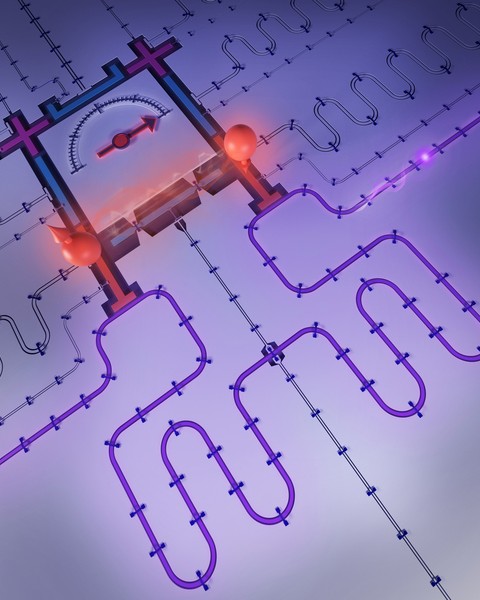
However, realizing this promise requires resilient and extensible hardware. One challenge in building a large-scale quantum computer is that researchers must find an effective way to interconnect quantum information nodes — smaller-scale processing nodes separated across a computer chip. Because quantum computers are fundamentally different from classical computers, conventional techniques used to communicate electronic information do not directly translate to quantum devices. However, one requirement is certain: Whether via a classical or a quantum interconnect, the carried information must be transmitted and received.
Complete article from MIT News.
Explore
Electrons in Moiré Crystals Explore Higher-dimensional Quantum Worlds
Department of Physics
MIT physicists have discovered 3D “moiré crystals” that simulate four-dimensional quantum materials to a T.
Discovering the Joy of Future-forward Electrical Engineering
Jane Halpern | Department of Electrical Engineering and Computer Science
One year in, MIT’s hands-on 6-5 (Electrical Engineering With Computing) degree program is already one of the most popular majors among first-year students.
New Photonic Device Efficiently Beams Light into Free Space
Adam Zewe | MIT News
Light-emitting structures that curl off the chip surface could enable advanced displays, high-speed optical communications, and larger-scale quantum computers.