February 5, 2025
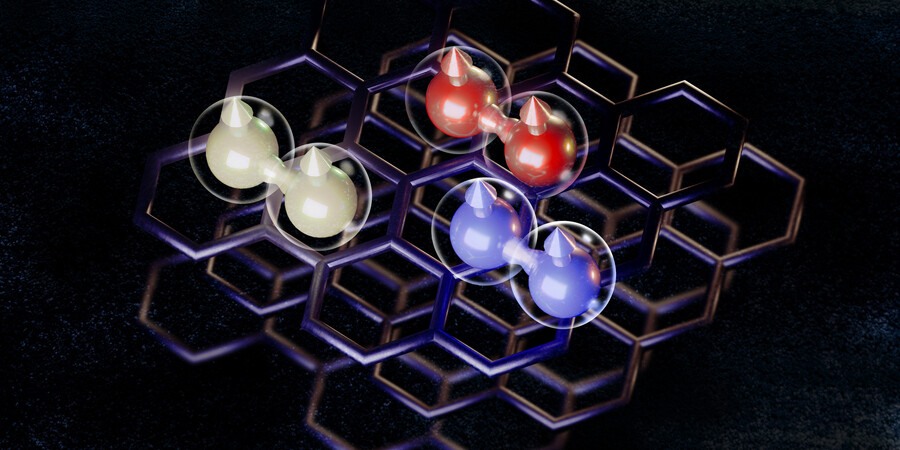
Superconducting materials are similar to the carpool lane in a congested interstate. Like commuters who ride together, electrons that pair up can bypass the regular traffic, moving through the material with zero friction.
But just as with carpools, how easily electron pairs can flow depends on a number of conditions, including the density of pairs that are moving through the material. This “superfluid stiffness,” or the ease with which a current of electron pairs can flow, is a key measure of a material’s superconductivity.
Physicists at MIT and Harvard University have now directly measured superfluid stiffness for the first time in “magic-angle” graphene — materials that are made from two or more atomically thin sheets of graphene twisted with respect to each other at just the right angle to enable a host of exceptional properties, including unconventional superconductivity.
Complete article from MIT News.
Explore
Efficient cooling method could enable chip-based trapped-ion quantum computers
Adam Zewe | MIT News
New technique could improve the scalability of trapped-ion quantum computers, an essential step toward making them practically useful.
What Makes a Good Proton Conductor?
Zach Winn | MIT News
MIT researchers found a way to predict how efficiently materials can transport protons in clean energy devices and other advanced technologies.
New Materials Could Boost the Energy Efficiency of Microelectronics
Adam Zewe | MIT News
By stacking multiple active components based on new materials on the back end of a computer chip, this new approach reduces the amount of energy wasted during computation.