
November 27, 2023
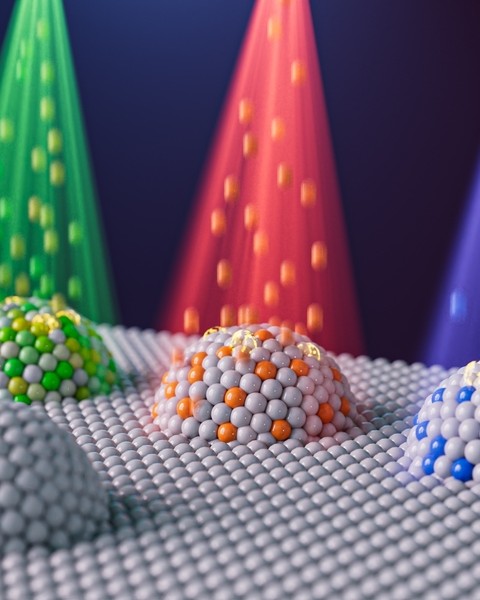
MIT researchers and colleagues have demonstrated a way to precisely control the size, composition, and other properties of nanoparticles key to the reactions involved in a variety of clean energy and environmental technologies. They did so by leveraging ion irradiation, a technique in which beams of charged particles bombard a material.
They went on to show that nanoparticles created this way have superior performance over their conventionally made counterparts.
“The materials we have worked on could advance several technologies, from fuel cells to generate CO2-free electricity to the production of clean hydrogen feedstocks for the chemical industry [through electrolysis cells],” says Bilge Yildiz, leader of the work and a professor in MIT’s departments of Nuclear Science and Engineering and Materials Science and Engineering.
Complete article from MIT News.
Explore
What Makes a Good Proton Conductor?
Zach Winn | MIT News
MIT researchers found a way to predict how efficiently materials can transport protons in clean energy devices and other advanced technologies.

Lisa Su ’90, SM ’91, PhD ’94 to deliver MIT’s 2026 Commencement address
Kathy Wren | MIT News
An electrical engineer by training, Su is the chair and CEO of the semiconductor company AMD.

New Materials Could Boost the Energy Efficiency of Microelectronics
Adam Zewe | MIT News
By stacking multiple active components based on new materials on the back end of a computer chip, this new approach reduces the amount of energy wasted during computation.


