

July 31, 2023
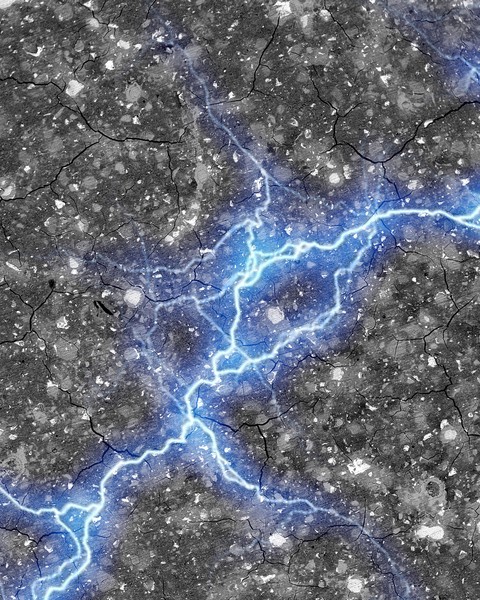
Two of humanity’s most ubiquitous historical materials, cement and carbon black (which resembles very fine charcoal), may form the basis for a novel, low-cost energy storage system, according to a new study. The technology could facilitate the use of renewable energy sources such as solar, wind, and tidal power by allowing energy networks to remain stable despite fluctuations in renewable energy supply.
The two materials, the researchers found, can be combined with water to make a supercapacitor — an alternative to batteries — that could provide storage of electrical energy. As an example, the MIT researchers who developed the system say that their supercapacitor could eventually be incorporated into the concrete foundation of a house, where it could store a full day’s worth of energy while adding little (or no) to the cost of the foundation and still providing the needed structural strength. The researchers also envision a concrete roadway that could provide contactless recharging for electric cars as they travel over that road.
The simple but innovative technology is described this week in the journal PNAS, in a paper by MIT professors Franz-Josef Ulm, Admir Masic, and Yang-Shao Horn, and four others at MIT and at the Wyss Institute for Biologically Inspired Engineering.
Complete article from MIT News.
Explore
MIT Researchers use AI to Uncover Atomic Defects in Materials
Zach Winn | MIT News
A new model measures defects that can be leveraged to improve materials’ mechanical strength, heat transfer, and energy-conversion efficiency.
“Near-misses” in Particle Accelerators can Illuminate New Physics, Study finds
Jennifer Chu | MIT News
Physicists discovered new properties of the strong force by analyzing what happens when light-speed particles skim by each other.
Why Solid-state Batteries Keep Short-circuiting
Zach Winn | MIT News
New insights into metallic cracks that harm battery performance could advance the longstanding quest to develop energy-dense solid-state batteries.


