
October 30, 2023
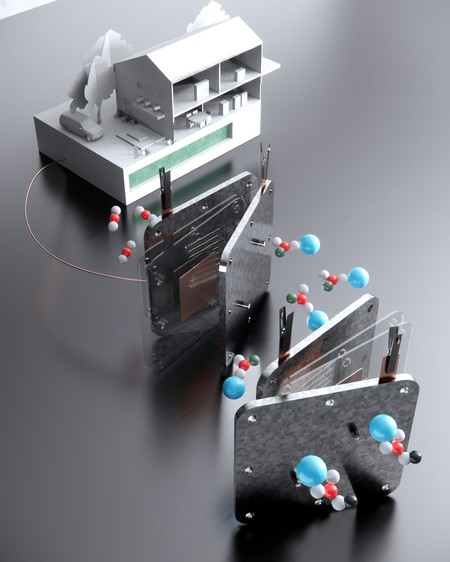
The search is on worldwide to find ways to extract carbon dioxide from the air or from power plant exhaust and then make it into something useful. One of the more promising ideas is to make it into a stable fuel that can replace fossil fuels in some applications. But most such conversion processes have had problems with low carbon efficiency, or they produce fuels that can be hard to handle, toxic, or flammable.
Now, researchers at MIT and Harvard University have developed an efficient process that can convert carbon dioxide into formate, a liquid or solid material that can be used like hydrogen or methanol to power a fuel cell and generate electricity. Potassium or sodium formate, already produced at industrial scales and commonly used as a de-icer for roads and sidewalks, is nontoxic, nonflammable, easy to store and transport, and can remain stable in ordinary steel tanks to be used months, or even years, after its production.
Complete article from MIT News.
Explore
MIT Researchers use AI to Uncover Atomic Defects in Materials
Zach Winn | MIT News
A new model measures defects that can be leveraged to improve materials’ mechanical strength, heat transfer, and energy-conversion efficiency.
“Near-misses” in Particle Accelerators can Illuminate New Physics, Study finds
Jennifer Chu | MIT News
Physicists discovered new properties of the strong force by analyzing what happens when light-speed particles skim by each other.
Why Solid-state Batteries Keep Short-circuiting
Zach Winn | MIT News
New insights into metallic cracks that harm battery performance could advance the longstanding quest to develop energy-dense solid-state batteries.