
February 21, 2024
The electron is the basic unit of electricity, as it carries a single negative charge. This is what we’re taught in high school physics, and it is overwhelmingly the case in most materials in nature.
But in very special states of matter, electrons can splinter into fractions of their whole. This phenomenon, known as “fractional charge,” is exceedingly rare, and if it can be corralled and controlled, the exotic electronic state could help to build resilient, fault-tolerant quantum computers.
To date, this effect, known to physicists as the “fractional quantum Hall effect,” has been observed a handful of times, and mostly under very high, carefully maintained magnetic fields. Only recently have scientists seen the effect in a material that did not require such powerful magnetic manipulation.
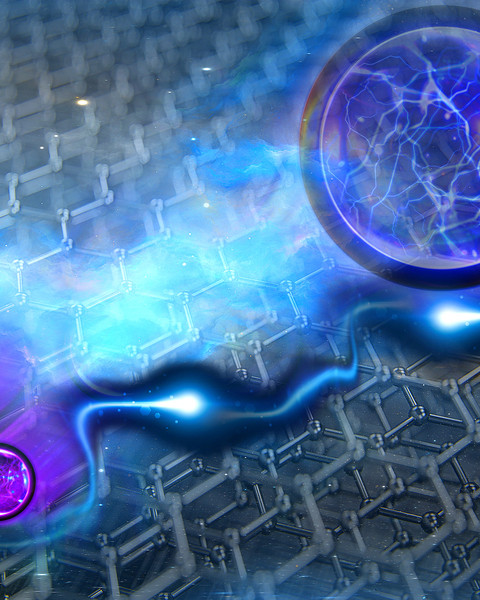
Now, MIT physicists have observed the elusive fractional charge effect, this time in a simpler material: five layers of graphene — an atom-thin layer of carbon that stems from graphite and common pencil lead.
Complete article from MIT News.
Explore
MIT Engineers Design Structures that Compute with Heat
Adam Zewe | MIT News
By leveraging excess heat instead of electricity, microscopic silicon structures could enable more energy-efficient thermal sensing and signal processing.

Pablo Jarillo-Herrero wins BBVA Foundation Frontiers of Knowledge Award
MIT physicist shares award for influential work on “magic-angle” graphene.
Materials Research Laboratory
What Makes a Good Proton Conductor?
Zach Winn | MIT News
MIT researchers found a way to predict how efficiently materials can transport protons in clean energy devices and other advanced technologies.


