

September 4, 2024
Imagine how a phone call works: Your voice is converted into electronic signals, shifted up to higher frequencies, transmitted over long distances, and then shifted back down so it can be heard clearly on the other end. The process enabling this shifting of signal frequencies is called frequency mixing, and it is essential for communication technologies like radio and Wi-Fi.
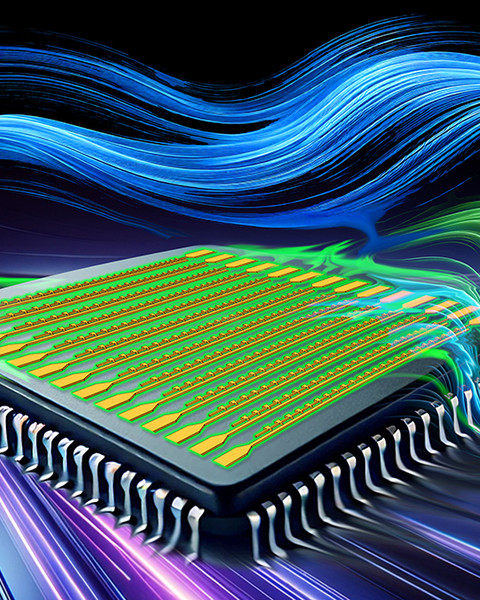
Now imagine a frequency mixer that works at a quadrillion (PHz, petahertz) times per second. The MIT team’s demonstration of a lightwave-electronic mixer at petahertz-scale frequencies is a first step toward making communication technology faster, and progresses research toward developing new, miniaturized lightwave electronic circuitry capable of handling optical signals directly at the nanoscale.
Complete article from MIT News.
Explore
Discovery helps explain why solid-state batteries often fail
Zach Winn | MIT News
New research could help prevent the formation of tiny seeds of lithium metal within the electrolyte, enabling batteries that charge faster and last longer.

MIT researchers advance toward greater bandwidth, more energy-efficient communications
Elizabeth A. Thomson | Materials Research Laboratory
The FUTUR-IC research program integrates electronics and photonics in microchip systems.

Graphene can hold multiple states of superconductivity, a new study finds
Jennifer Chu | MIT News
What’s more, the superconducting states get stronger under conditions expected to kill them.


