

Monday, October 3, 2022
Speaker: Arvind, MIT
In this episode of MIT’S Computer Science and Artificial Intelligence Labs alliances podcast series MIT Professor Arvind, the Johnson professor of Computer Science and Engineering, details his work in Near-storage computing. He explains how he’s using flash storage instead of massive amounts of DRAM for big data problems. In Arvind’s research group, the Computational Structures Group, their mission is to enable the creation and development of high performance reliable and secure computing systems that are easy to interact with. The group is currently conducting research in the areas of computer architecture, hardware synthesis, computer security, and VLSI design.
Listen to the complete podcast.
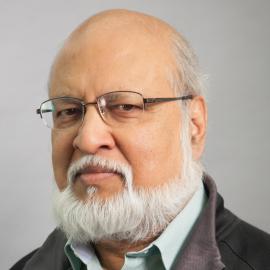 Speaker Bio: Arvind is the Charles W. and Jennifer C. Johnson Professor of Computer Science, and head of the computer science unit, in the Department of Electrical Engineering and Computer Science at MIT, as well as a member of the Computer Science and Artificial Intelligence Laboratory. Arvind’s research concentrates on the specification and synthesis of complex digital systems, including microprocessors and accelerators, using a formalism known as guarded atomic actions. Previously, his interests have included all aspects of parallel computing and declarative programming languages. He has contributed to the development of dynamic dataflow architectures, the implicitly parallel programming languages Id and pH, and the compilation of these types of languages on parallel machines. Arvind received his PhD and MS in computer science from the University of Minnesota and his BTech in electrical engineering from the Indian Institute of Technology, Kanpur. He is a fellow of IEEE and ACM, and a member of the National Academy of Engineering and the American Academy of Arts and Sciences.
Explore
Discovery helps explain why solid-state batteries often fail
Zach Winn | MIT News
New research could help prevent the formation of tiny seeds of lithium metal within the electrolyte, enabling batteries that charge faster and last longer.
Graphene can hold multiple states of superconductivity, a new study finds
Jennifer Chu | MIT News
What’s more, the superconducting states get stronger under conditions expected to kill them.

Improving the performance of high-power electronics
Adam Zewe | MIT News
By using a thin layer of diamond to manage excessive heat, researchers can boost the speed and energy-efficiency of next-generation wireless devices.