Thursday, February 24, 2022 | 2:00 pm ET
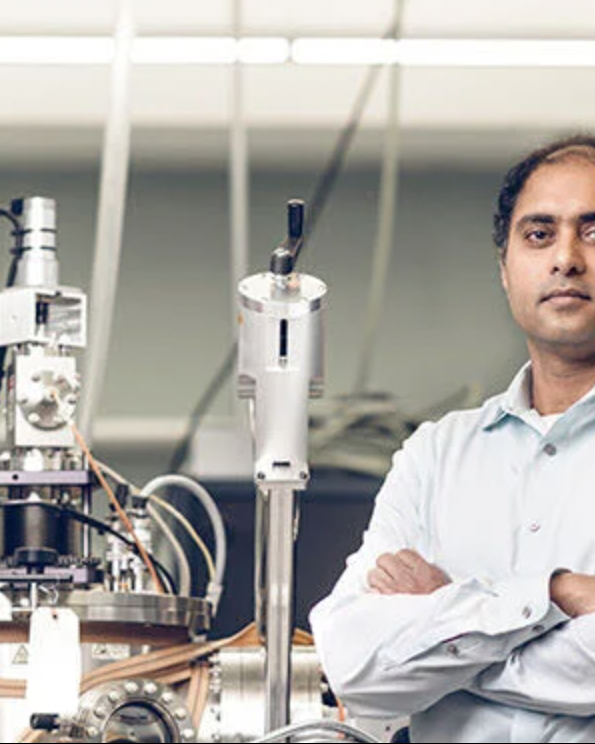
Speaker: Shriram Ramanathan, Purdue University
Please join the Zoom webinar here on February 24.
I will share my vision and enthusiasm for the growing fields of brain-inspired computing and robotics. The focus of my presentation will be on metal-insulator transitions in quantum materials such as correlated perovskite semiconductors that can be used to emulate the characteristics of neurons and synapses in the brain and serve as building blocks for AI hardware. We will then discuss how features of intelligence noted in various insects, mammals and birds by biologists can be implemented in electronic devices and circuits for learning and decision-making. Creation of neural links between brains of live mice and electronics will be then presented (few refs: Science (373, 352, 2021), PNAS (118, e2103934118, 2021), PNAS (116, 21992, 2019)).
Speaker Bio: Shriram Ramanathan is a professor in the School of Engineering (MSE, ECE courtesy) at Purdue University. He received his PhD from Stanford University and was a research staff member at Components Research, Intel for over three years. He then served on the Applied Physics faculty at Harvard University for nearly a decade. Their group conducts research in oxide semiconductors for neuromorphic computing; opto-electronics and haptic intelligence and collaborate with diverse set of research groups across engineering and natural sciences.
For a list of all talks at the NanoBio Seminar Series Spring ’22, see here
Explore
What Makes a Good Proton Conductor?
Zach Winn | MIT News
MIT researchers found a way to predict how efficiently materials can transport protons in clean energy devices and other advanced technologies.
Lisa Su ’90, SM ’91, PhD ’94 to deliver MIT’s 2026 Commencement address
Kathy Wren | MIT News
An electrical engineer by training, Su is the chair and CEO of the semiconductor company AMD.
New Materials Could Boost the Energy Efficiency of Microelectronics
Adam Zewe | MIT News
By stacking multiple active components based on new materials on the back end of a computer chip, this new approach reduces the amount of energy wasted during computation.