

October 30, 2023
The search is on worldwide to find ways to extract carbon dioxide from the air or from power plant exhaust and then make it into something useful. One of the more promising ideas is to make it into a stable fuel that can replace fossil fuels in some applications. But most such conversion processes have had problems with low carbon efficiency, or they produce fuels that can be hard to handle, toxic, or flammable.
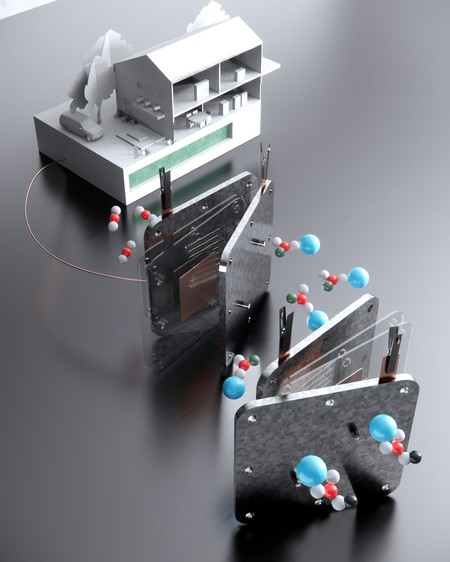
Now, researchers at MIT and Harvard University have developed an efficient process that can convert carbon dioxide into formate, a liquid or solid material that can be used like hydrogen or methanol to power a fuel cell and generate electricity. Potassium or sodium formate, already produced at industrial scales and commonly used as a de-icer for roads and sidewalks, is nontoxic, nonflammable, easy to store and transport, and can remain stable in ordinary steel tanks to be used months, or even years, after its production.
Complete article from MIT News.
Explore
Tomás Palacios appointed Director of ISN
Office of the Vice President for Research
As director, Tomás will lead ISN’s research mission and build communities within MIT and with external partners.

MIT Engineers Design Structures that Compute with Heat
Adam Zewe | MIT News
By leveraging excess heat instead of electricity, microscopic silicon structures could enable more energy-efficient thermal sensing and signal processing.

Pablo Jarillo-Herrero wins BBVA Foundation Frontiers of Knowledge Award
MIT physicist shares award for influential work on “magic-angle” graphene.
Materials Research Laboratory


