
October 18, 2023
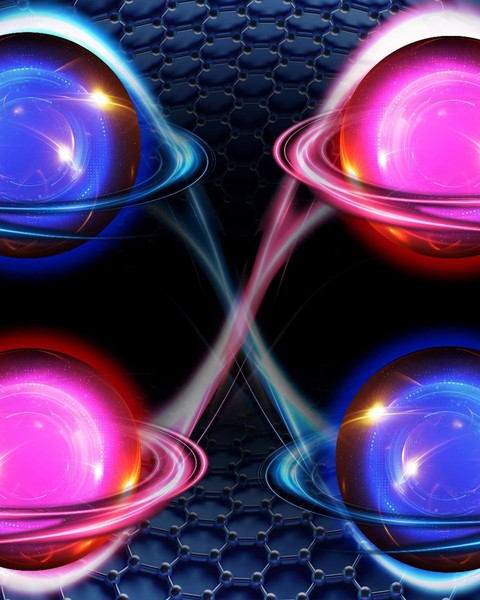
Ordinary pencil lead holds extraordinary properties when shaved down to layers as thin as an atom. A single, atom-thin sheet of graphite, known as graphene, is just a tiny fraction of the width of a human hair. Under a microscope, the material resembles a chicken-wire of carbon atoms linked in a hexagonal lattice.
Despite its waif-like proportions, scientists have found over the years that graphene is exceptionally strong. And when the material is stacked and twisted in specific contortions, it can take on surprising electronic behavior.
Now, MIT physicists have discovered another surprising property in graphene: When stacked in five layers, in a rhombohedral pattern, graphene takes on a very rare, “multiferroic” state, in which the material exhibits both unconventional magnetism and an exotic type of electronic behavior, which the team has coined ferro-valleytricity.
“Graphene is a fascinating material,” says team leader Long Ju, assistant professor of physics at MIT. “Every layer you add gives you essentially a new material. And now this is the first time we see ferro-valleytricity, and unconventional magnetism, in five layers of graphene. But we don’t see this property in one, two, three, or four layers.”
The discovery could help engineers design ultra-low-power, high-capacity data storage devices for classical and quantum computers.
Complete article from MIT News.
Explore
Efficient cooling method could enable chip-based trapped-ion quantum computers
Adam Zewe | MIT News
New technique could improve the scalability of trapped-ion quantum computers, an essential step toward making them practically useful.
What Makes a Good Proton Conductor?
Zach Winn | MIT News
MIT researchers found a way to predict how efficiently materials can transport protons in clean energy devices and other advanced technologies.
New Materials Could Boost the Energy Efficiency of Microelectronics
Adam Zewe | MIT News
By stacking multiple active components based on new materials on the back end of a computer chip, this new approach reduces the amount of energy wasted during computation.


