
April 24, 2024
Entanglement is a form of correlation between quantum objects, such as particles at the atomic scale. This uniquely quantum phenomenon cannot be explained by the laws of classical physics, yet it is one of the properties that explains the macroscopic behavior of quantum systems.
Because entanglement is central to the way quantum systems work, understanding it better could give scientists a deeper sense of how information is stored and processed efficiently in such systems.
Qubits, or quantum bits, are the building blocks of a quantum computer. However, it is extremely difficult to make specific entangled states in many-qubit systems, let alone investigate them. There are also a variety of entangled states, and telling them apart can be challenging.
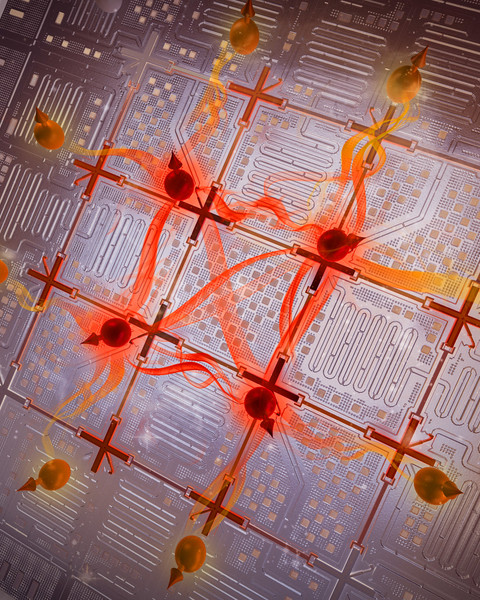
Now, MIT researchers have demonstrated a technique to efficiently generate entanglement among an array of superconducting qubits that exhibit a specific type of behavior.
Complete article from MIT News.
Explore
MIDDAS: Memory Integration and Data Dis-Aggregation
Wednesday, November 19, 2025 | 12:00 - 1:00pm ET
Hybrid
Zoom & MIT Campus
New 3D Chips could Make Electronics Faster and more Energy-Efficient
Adam Zewe | MIT News
The low-cost, scalable technology can seamlessly integrate high-speed gallium nitride transistors onto a standard silicon chip.
Closing in on Superconducting Semiconductors
Julianna Mullen | Plasma Science and Fusion Center
Plasma Science and Fusion Center researchers created a superconducting circuit that could one day replace semiconductor components in quantum and high-performance computing systems.