
June 11, 2024
Boosting the performance of solar cells, transistors, LEDs, and batteries will require better electronic materials, made from novel compositions that have yet to be discovered.
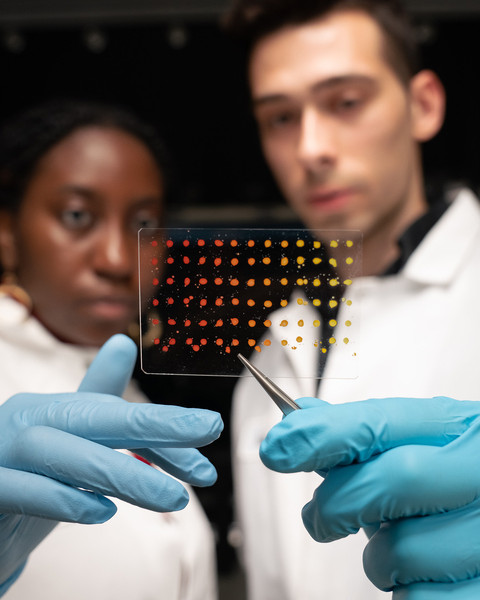
To speed up the search for advanced functional materials, scientists are using AI tools to identify promising materials from hundreds of millions of chemical formulations. In tandem, engineers are building machines that can print hundreds of material samples at a time based on chemical compositions tagged by AI search algorithms.
But to date, there’s been no similarly speedy way to confirm that these printed materials actually perform as expected. This last step of material characterization has been a major bottleneck in the pipeline of advanced materials screening.
Now, a new computer vision technique developed by MIT engineers significantly speeds up the characterization of newly synthesized electronic materials. The technique automatically analyzes images of printed semiconducting samples and quickly estimates two key electronic properties for each sample: band gap (a measure of electron activation energy) and stability (a measure of longevity).
Complete article from MIT News.
Explore
MIT Researchers use AI to Uncover Atomic Defects in Materials
Zach Winn | MIT News
A new model measures defects that can be leveraged to improve materials’ mechanical strength, heat transfer, and energy-conversion efficiency.
“Near-misses” in Particle Accelerators can Illuminate New Physics, Study finds
Jennifer Chu | MIT News
Physicists discovered new properties of the strong force by analyzing what happens when light-speed particles skim by each other.
Why Solid-state Batteries Keep Short-circuiting
Zach Winn | MIT News
New insights into metallic cracks that harm battery performance could advance the longstanding quest to develop energy-dense solid-state batteries.