

Adam Zewe | MIT News Office
January 5, 2023
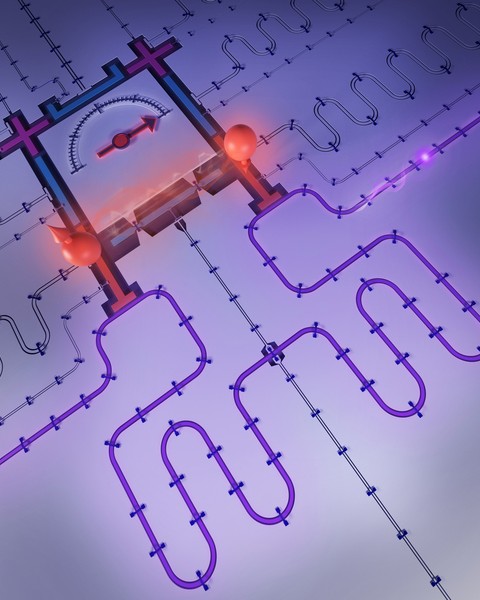
Quantum computers hold the promise of performing certain tasks that are intractable even on the world’s most powerful supercomputers. In the future, scientists anticipate using quantum computing to emulate materials systems, simulate quantum chemistry, and optimize hard tasks, with impacts potentially spanning finance to pharmaceuticals.
However, realizing this promise requires resilient and extensible hardware. One challenge in building a large-scale quantum computer is that researchers must find an effective way to interconnect quantum information nodes — smaller-scale processing nodes separated across a computer chip. Because quantum computers are fundamentally different from classical computers, conventional techniques used to communicate electronic information do not directly translate to quantum devices. However, one requirement is certain: Whether via a classical or a quantum interconnect, the carried information must be transmitted and received.
Complete article from MIT News.
Explore
Tomás Palacios appointed Director of ISN
Office of the Vice President for Research
As director, Tomás will lead ISN’s research mission and build communities within MIT and with external partners.
MIT Engineers Design Structures that Compute with Heat
Adam Zewe | MIT News
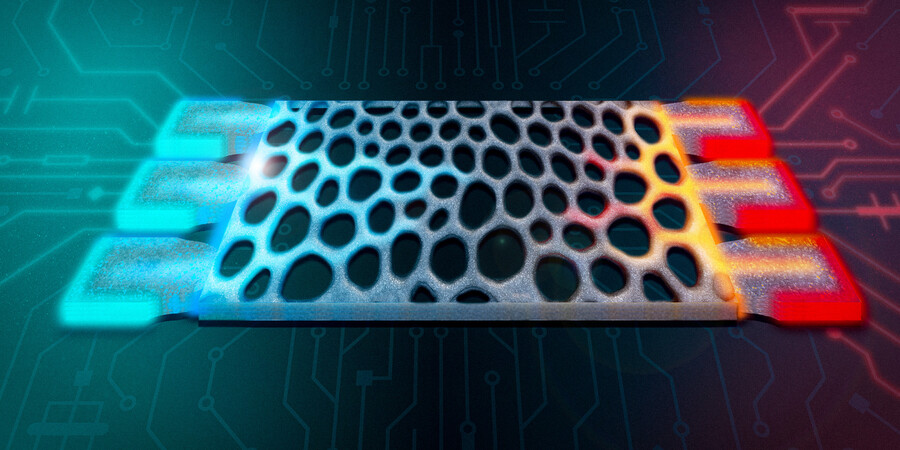
By leveraging excess heat instead of electricity, microscopic silicon structures could enable more energy-efficient thermal sensing and signal processing.

Efficient cooling method could enable chip-based trapped-ion quantum computers
Adam Zewe | MIT News
New technique could improve the scalability of trapped-ion quantum computers, an essential step toward making them practically useful.


