October 11, 2023
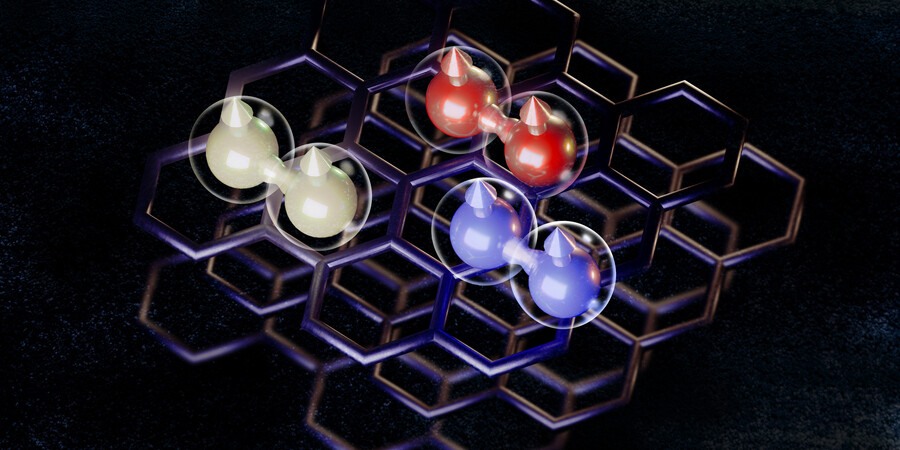
In research that could jump-start interest into an enigmatic class of materials known as quasicrystals, MIT scientists and colleagues have discovered a relatively simple, flexible way to create new atomically thin versions that can be tuned for important phenomena. In work reported in a recent issue of Nature, they describe doing just that to make the materials exhibit superconductivity and more.
The research introduces a new platform for not only learning more about quasicrystals, but also exploring exotic phenomena that can be hard to study but could lead to important applications and new physics. For example, a better understanding of superconductivity, in which electrons pass through a material with no resistance, could allow much more efficient electronic devices.
The work brings together two previously unconnected fields: quasicrystals and twistronics. The latter is the specialty of Pablo Jarillo-Herrero, the Cecil and Ida Green Professor of Physics at MIT and corresponding author of the new Nature paper, whose “magic-angle” graphene breakthrough in 2018 jump-started the field.
Complete article from MIT News.
Explore
What Makes a Good Proton Conductor?
Zach Winn | MIT News
MIT researchers found a way to predict how efficiently materials can transport protons in clean energy devices and other advanced technologies.
New Materials Could Boost the Energy Efficiency of Microelectronics
Adam Zewe | MIT News
By stacking multiple active components based on new materials on the back end of a computer chip, this new approach reduces the amount of energy wasted during computation.
MIT Physicists Observe Key Evidence of Unconventional Superconductivity in Magic-angle Graphene
The findings could open a route to new forms of higher-temperature superconductors.
Jennifer Chu | MIT News