July 23, 2024
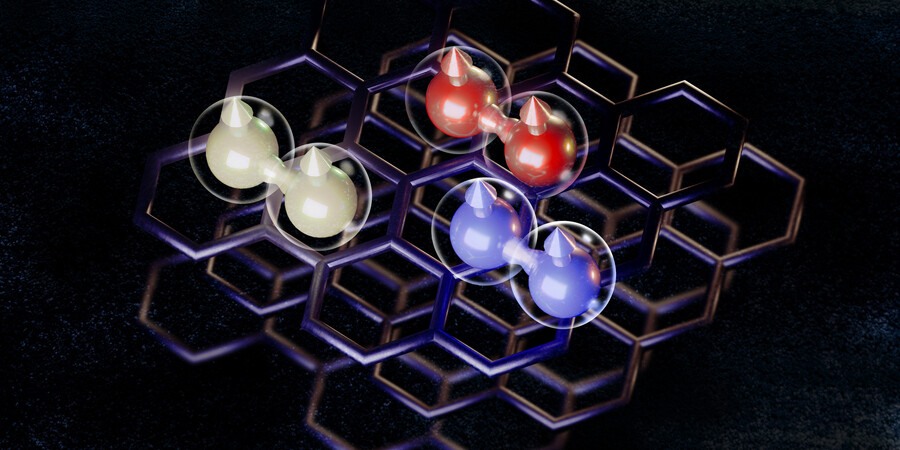
As the name suggests, most electronic devices today work through the movement of electrons. But materials that can efficiently conduct protons — the nucleus of the hydrogen atom — could be key to a number of important technologies for combating global climate change.
Most proton-conducting inorganic materials available now require undesirably high temperatures to achieve sufficiently high conductivity. However, lower-temperature alternatives could enable a variety of technologies, such as more efficient and durable fuel cells to produce clean electricity from hydrogen, electrolyzers to make clean fuels such as hydrogen for transportation, solid-state proton batteries, and even new kinds of computing devices based on iono-electronic effects.
In order to advance the development of proton conductors, MIT engineers have identified certain traits of materials that give rise to fast proton conduction.
Complete article from MIT News.
Explore
MIT Researchers use AI to Uncover Atomic Defects in Materials
Zach Winn | MIT News
A new model measures defects that can be leveraged to improve materials’ mechanical strength, heat transfer, and energy-conversion efficiency.
“Near-misses” in Particle Accelerators can Illuminate New Physics, Study finds
Jennifer Chu | MIT News
Physicists discovered new properties of the strong force by analyzing what happens when light-speed particles skim by each other.
Why Solid-state Batteries Keep Short-circuiting
Zach Winn | MIT News
New insights into metallic cracks that harm battery performance could advance the longstanding quest to develop energy-dense solid-state batteries.