Jennifer Chu | MIT News Office
January 30, 2023
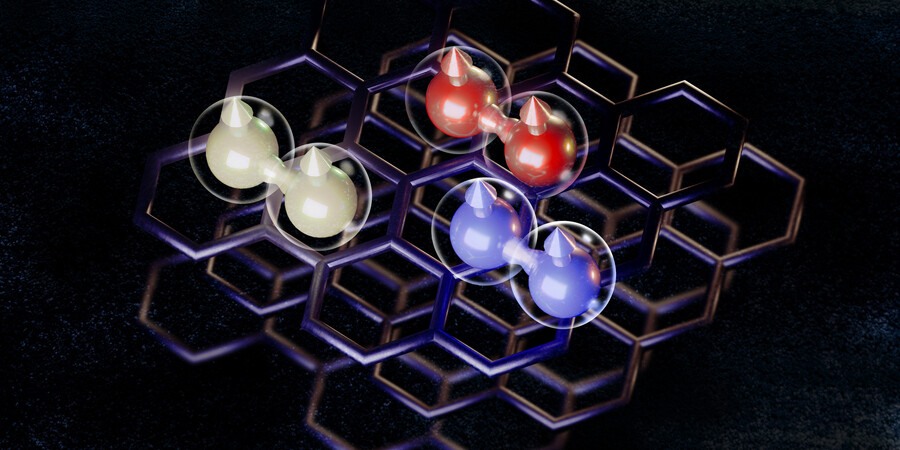
With some careful twisting and stacking, MIT physicists have revealed a new and exotic property in “magic-angle” graphene: superconductivity that can be turned on and off with an electric pulse, much like a light switch.
The discovery could lead to ultrafast, energy-efficient superconducting transistors for neuromorphic devices — electronics designed to operate in a way similar to the rapid on/off firing of neurons in the human brain.
Magic-angle graphene refers to a very particular stacking of graphene — an atom-thin material made from carbon atoms that are linked in a hexagonal pattern resembling chicken wire. When one sheet of graphene is stacked atop a second sheet at a precise “magic” angle, the twisted structure creates a slightly offset “moiré” pattern, or superlattice, that is able to support a host of surprising electronic behaviors.
Complete article from MIT News.
Explore
MIT Engineers Design Structures that Compute with Heat
Adam Zewe | MIT News
By leveraging excess heat instead of electricity, microscopic silicon structures could enable more energy-efficient thermal sensing and signal processing.
Pablo Jarillo-Herrero wins BBVA Foundation Frontiers of Knowledge Award
MIT physicist shares award for influential work on “magic-angle” graphene.
Materials Research Laboratory
What Makes a Good Proton Conductor?
Zach Winn | MIT News
MIT researchers found a way to predict how efficiently materials can transport protons in clean energy devices and other advanced technologies.