
August 2, 2023
Engineers are constantly searching for materials with novel, desirable property combinations. For example, an ultra-strong, lightweight material could be used to make airplanes and cars more fuel-efficient, or a material that is porous and biomechanically friendly could be useful for bone implants.
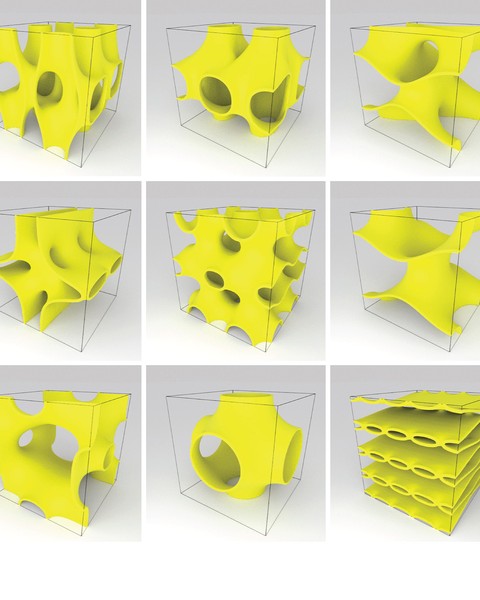
Cellular metamaterials — artificial structures composed of units, or cells, that repeat in various patterns — can help achieve these goals. But it is difficult to know which cellular structure will lead to the desired properties. Even if one focuses on structures made of smaller building blocks like interconnected beams or thin plates, there are an infinite number of possible arrangements to consider. So, engineers can manually explore only a small fraction of all the cellular metamaterials that are hypothetically possible.
Researchers from MIT and the Institute of Science and Technology Austria have developed a computational technique that makes it easier for a user to quickly design a metamaterial cell from any of those smaller building blocks, and then evaluate the resulting metamaterial’s properties.
Their approach, like a specialized CAD (computer-aided design) system for metamaterials, allows an engineer to quickly model even very complex metamaterials and experiment with designs that may have otherwise taken days to develop. The user-friendly interface also enables the user to explore the entire space of potential metamaterial shapes, since all building blocks are at their disposal.
Complete article from MIT News.
Explore
MIT Engineers Design Structures that Compute with Heat
Adam Zewe | MIT News
By leveraging excess heat instead of electricity, microscopic silicon structures could enable more energy-efficient thermal sensing and signal processing.
Pablo Jarillo-Herrero wins BBVA Foundation Frontiers of Knowledge Award
MIT physicist shares award for influential work on “magic-angle” graphene.
Materials Research Laboratory
What Makes a Good Proton Conductor?
Zach Winn | MIT News
MIT researchers found a way to predict how efficiently materials can transport protons in clean energy devices and other advanced technologies.