
May 29, 2024
Quantum computers hold the promise of being able to quickly solve extremely complex problems that might take the world’s most powerful supercomputer decades to crack.
But achieving that performance involves building a system with millions of interconnected building blocks called qubits. Making and controlling so many qubits in a hardware architecture is an enormous challenge that scientists around the world are striving to meet.
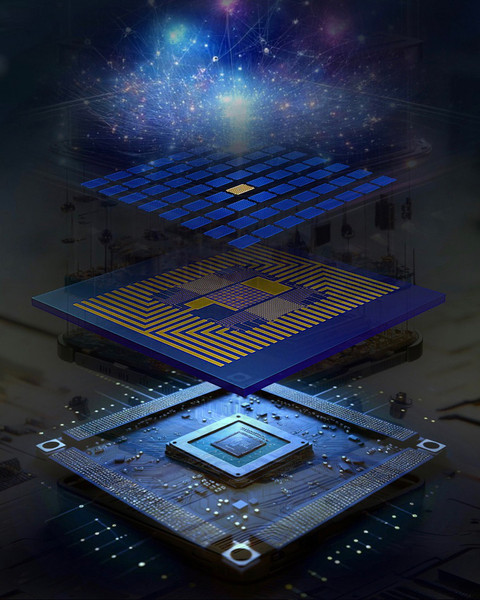
Toward this goal, researchers at MIT and MITRE have demonstrated a scalable, modular hardware platform that integrates thousands of interconnected qubits onto a customized integrated circuit. This “quantum-system-on-chip” (QSoC) architecture enables the researchers to precisely tune and control a dense array of qubits. Multiple chips could be connected using optical networking to create a large-scale quantum communication network.
By tuning qubits across 11 frequency channels, this QSoC architecture allows for a new proposed protocol of “entanglement multiplexing” for large-scale quantum computing.
Complete article from MIT News.
Explore
MIT Engineers Design Structures that Compute with Heat
Adam Zewe | MIT News
By leveraging excess heat instead of electricity, microscopic silicon structures could enable more energy-efficient thermal sensing and signal processing.
Efficient cooling method could enable chip-based trapped-ion quantum computers
Adam Zewe | MIT News
New technique could improve the scalability of trapped-ion quantum computers, an essential step toward making them practically useful.
What Makes a Good Proton Conductor?
Zach Winn | MIT News
MIT researchers found a way to predict how efficiently materials can transport protons in clean energy devices and other advanced technologies.