Jennifer Chu | MIT News Office
February 1, 2023
Take apart your laptop screen, and at its heart you’ll find a plate patterned with pixels of red, green, and blue LEDs, arranged end to end like a meticulous Lite Brite display. When electrically powered, the LEDs together can produce every shade in the rainbow to generate full-color displays. Over the years, the size of individual pixels has shrunk, enabling many more of them to be packed into devices to produce sharper, higher-resolution digital displays.
But much like computer transistors, LEDs are reaching a limit to how small they can be while also performing effectively. This limit is especially noticeable in close-range displays such as augmented and virtual reality devices, where limited pixel density results in a “screen door effect” such that users perceive stripes in the space between pixels.
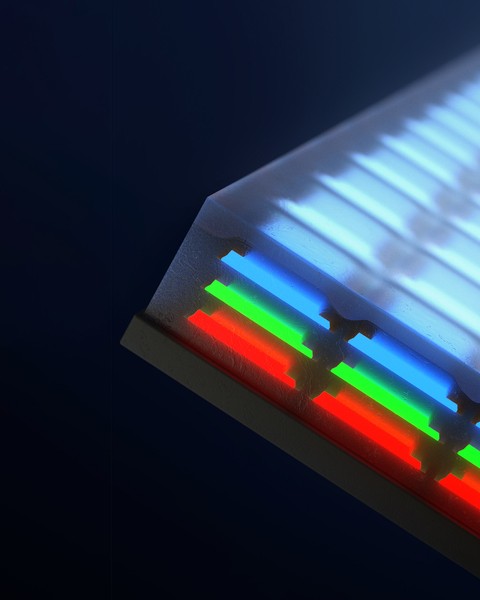
Now, MIT engineers have developed a new way to make sharper, defect-free displays. Instead of replacing red, green, and blue light-emitting diodes side by side in a horizontal patchwork, the team has invented a way to stack the diodes to create vertical, multicolored pixels.
Complete article from MIT News.
Explore
MIT Researchers use AI to Uncover Atomic Defects in Materials
Zach Winn | MIT News
A new model measures defects that can be leveraged to improve materials’ mechanical strength, heat transfer, and energy-conversion efficiency.
“Near-misses” in Particle Accelerators can Illuminate New Physics, Study finds
Jennifer Chu | MIT News
Physicists discovered new properties of the strong force by analyzing what happens when light-speed particles skim by each other.
Why Solid-state Batteries Keep Short-circuiting
Zach Winn | MIT News
New insights into metallic cracks that harm battery performance could advance the longstanding quest to develop energy-dense solid-state batteries.