


May 12, 2026
Quantum computers could someday solve pressing problems that are too convoluted for classical computers, such as modeling complex molecular interactions to streamline drug discovery and materials development.
But to build a superconducting quantum computer that is large and resilient enough for real-world applications, scientists must precisely engineer thousands of quantum circuits so they perform operations with the lowest possible error rate.
To help scientists design more predictable circuits, researchers from MIT and Lincoln Laboratory developed a technique to measure a property that can unexpectedly cause a superconducting quantum circuit to deviate from its expected behavior. Their analysis revealed the source of these distortions, known as second-order harmonic corrections, leading to underperforming circuit architectures.
Complete article from MIT News.
Explore
Graphene can hold multiple states of superconductivity, a new study finds
Jennifer Chu | MIT News
What’s more, the superconducting states get stronger under conditions expected to kill them.

Researchers “reprogram” materials by quickly rearranging their atoms
Zach Winn | MIT News
A new method for precisely moving columns of individual atoms within a material could give rise to exotic quantum properties.
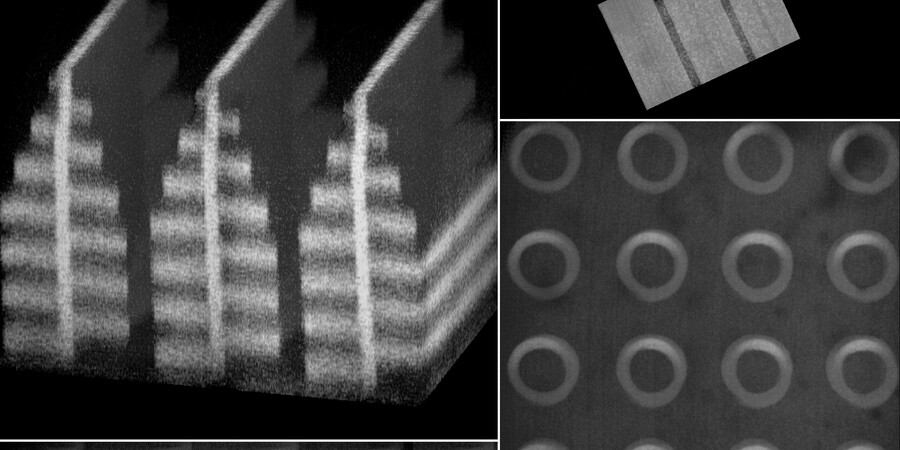
Powerful shrinking technique could enable devices that compute with light
Anne Trafton | MIT News
MIT researchers created tiny 3D photonic devices with features small enough to channel visible light.


