April 23, 2025
In metamaterials design, the name of the game has long been “stronger is better.”
Metamaterials are synthetic materials with microscopic structures that give the overall material exceptional properties. A huge focus has been in designing metamaterials that are stronger and stiffer than their conventional counterparts. But there’s a trade-off: The stiffer a material, the less flexible it is.
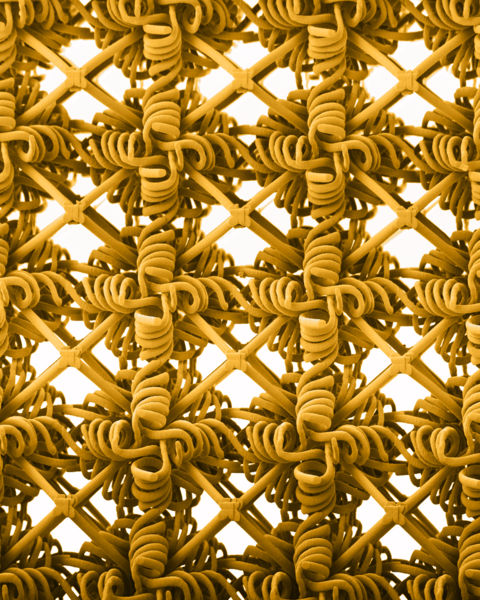
MIT engineers have now found a way to fabricate a metamaterial that is both strong and stretchy. The base material is typically highly rigid and brittle, but it is printed in precise, intricate patterns that form a structure that is both strong and flexible.
The key to the new material’s dual properties is a combination of stiff microscopic struts and a softer woven architecture. This microscopic “double network,” which is printed using a plexiglass-like polymer, produced a material that could stretch over four times its size without fully breaking. In comparison, the polymer in other forms has little to no stretch and shatters easily once cracked.
Complete article from MIT News.
Explore
What Makes a Good Proton Conductor?
Zach Winn | MIT News
MIT researchers found a way to predict how efficiently materials can transport protons in clean energy devices and other advanced technologies.
New Materials Could Boost the Energy Efficiency of Microelectronics
Adam Zewe | MIT News
By stacking multiple active components based on new materials on the back end of a computer chip, this new approach reduces the amount of energy wasted during computation.
MIT Physicists Observe Key Evidence of Unconventional Superconductivity in Magic-angle Graphene
The findings could open a route to new forms of higher-temperature superconductors.
Jennifer Chu | MIT News