

May 9, 2024
Jorg Scholvin can distinguish silicon materials just two nanometers apart in thickness with his naked eye. In the blanched rooms of Building 12, machines buzz a steady low hum. The MIT.nano veteran points out three thin, circular plates of varying colors on a metal table. The brownish-orange one, he says, is coated in a film 60 nanometers (nm) thick. The purple one corresponds to 68 nm, and light blue to 72 nm. “There are tools that can tell me this,” Dr. Scholvin ’00 PhD ’06 states from behind his cleanroom suit mask, but “I know from the color.”
These plates are 200-millimeter (8 inches in diameter) wafers, thin slices of semiconductor such as silicon. They are commonly used in industry as a base for etching and deposition to create microcircuits, solar cells, and other devices. MIT.nano houses instruments used in industry, as well as those geared specifically towards research.
The physics is simple enough: light waves travel down and either reflect off of the top surface of film or continue down through it, reflecting on the bottom surface. The light that our eyes see is a combination of the two waves, and the different colors are a result of the waves interfering with each other. The blue 72 nm wafer, for instance, indicates that light rays are constructively interfering in the blue range, whereas red and green wavelengths are destructively interfering. Oil spills and soap bubbles, with their rainbow patterns, display the same phenomenon, called thin film interference.
Complete article from The Tech.
Explore
Discovery helps explain why solid-state batteries often fail
Zach Winn | MIT News
New research could help prevent the formation of tiny seeds of lithium metal within the electrolyte, enabling batteries that charge faster and last longer.

MIT researchers advance toward greater bandwidth, more energy-efficient communications
Elizabeth A. Thomson | Materials Research Laboratory
The FUTUR-IC research program integrates electronics and photonics in microchip systems.
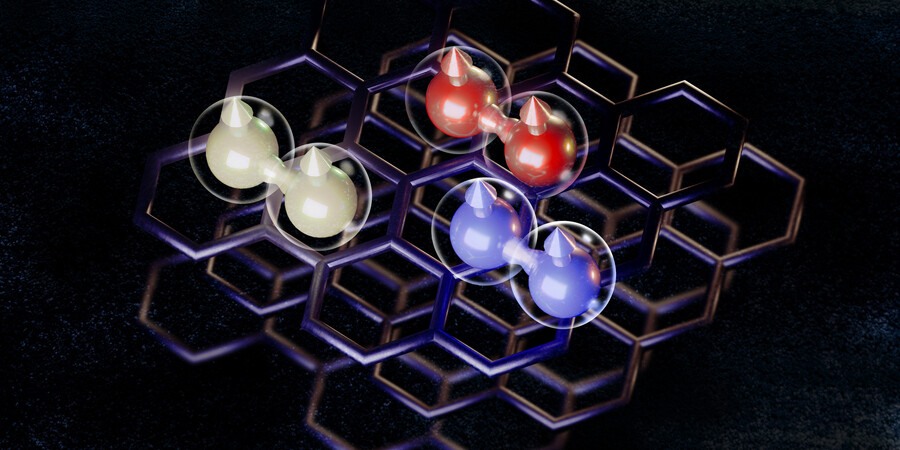
Graphene can hold multiple states of superconductivity, a new study finds
Jennifer Chu | MIT News
What’s more, the superconducting states get stronger under conditions expected to kill them.


