
April 3, 2024
Neutrons are subatomic particles that have no electric charge, unlike protons and electrons. That means that while the electromagnetic force is responsible for most of the interactions between radiation and materials, neutrons are essentially immune to that force.
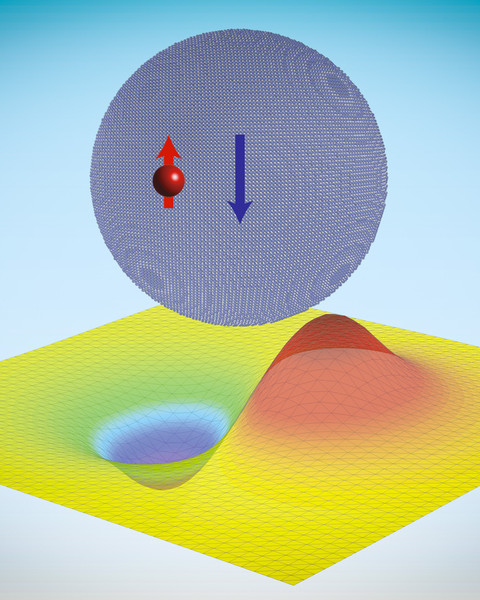
Instead, neutrons are held together inside an atom’s nucleus solely by something called the strong force, one of the four fundamental forces of nature. As its name implies, the force is indeed very strong, but only at very close range — it drops off so rapidly as to be negligible beyond 1/10,000 the size of an atom. But now, researchers at MIT have found that neutrons can actually be made to cling to particles called quantum dots, which are made up of tens of thousands of atomic nuclei, held there just by the strong force.
The new finding may lead to useful new tools for probing the basic properties of materials at the quantum level, including those arising from the strong force, as well as exploring new kinds of quantum information processing devices. The work is reported this week in the journal ACS Nano, in a paper by MIT graduate students Hao Tang and Guoqing Wang and MIT professors Ju Li and Paola Cappellaro of the Department of Nuclear Science and Engineering.
Complete article from MIT News.
Explore
Discovery helps explain why solid-state batteries often fail
Zach Winn | MIT News
New research could help prevent the formation of tiny seeds of lithium metal within the electrolyte, enabling batteries that charge faster and last longer.
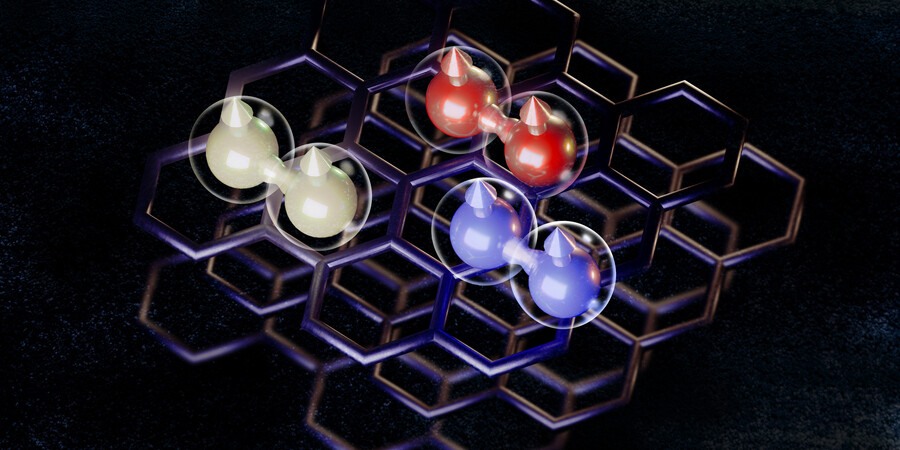
Graphene can hold multiple states of superconductivity, a new study finds
Jennifer Chu | MIT News
What’s more, the superconducting states get stronger under conditions expected to kill them.

Improving the performance of high-power electronics
Adam Zewe | MIT News
By using a thin layer of diamond to manage excessive heat, researchers can boost the speed and energy-efficiency of next-generation wireless devices.


