Jennifer Chu | MIT News Office
July 8, 2022
When it comes to graphene, it appears that superconductivity runs in the family.
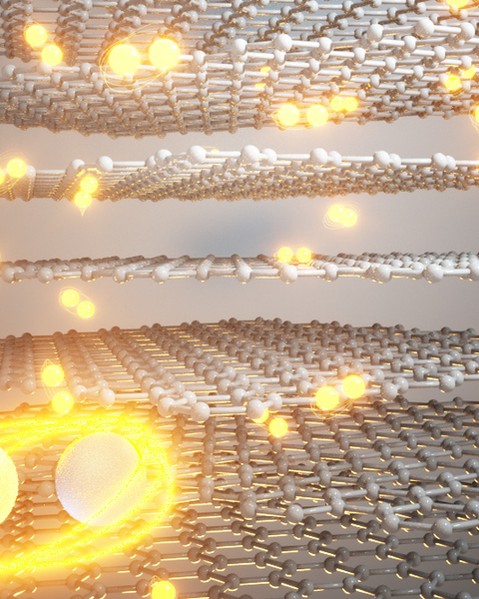
Graphene is a single-atom-thin material that can be exfoliated from the same graphite that is found in pencil lead. The ultrathin material is made entirely from carbon atoms that are arranged in a simple hexagonal pattern, similar to that of chicken wire. Since its isolation in 2004, graphene has been found to embody numerous remarkable properties in its single-layer form.
In 2018, MIT researchers found that if two graphene layers are stacked at a very specific “magic” angle, the twisted bilayer structure could exhibit robust superconductivity, a widely sought material state in which an electrical current can flow through with zero energy loss. Recently, the same group found a similar superconductive state exists in twisted trilayer graphene — a structure made from three graphene layers stacked at a precise, new magic angle.
Complete article from MIT News.
Explore
MIT Researchers use AI to Uncover Atomic Defects in Materials
Zach Winn | MIT News
A new model measures defects that can be leveraged to improve materials’ mechanical strength, heat transfer, and energy-conversion efficiency.
“Near-misses” in Particle Accelerators can Illuminate New Physics, Study finds
Jennifer Chu | MIT News
Physicists discovered new properties of the strong force by analyzing what happens when light-speed particles skim by each other.
Why Solid-state Batteries Keep Short-circuiting
Zach Winn | MIT News
New insights into metallic cracks that harm battery performance could advance the longstanding quest to develop energy-dense solid-state batteries.