

April 28, 2025
As demand grows for more powerful and efficient microelectronics systems, industry is turning to 3D integration — stacking chips on top of each other. This vertically layered architecture could allow high-performance processors, like those used for artificial intelligence, to be packaged closely with other highly specialized chips for communication or imaging. But technologists everywhere face a major challenge: how to prevent these stacks from overheating.
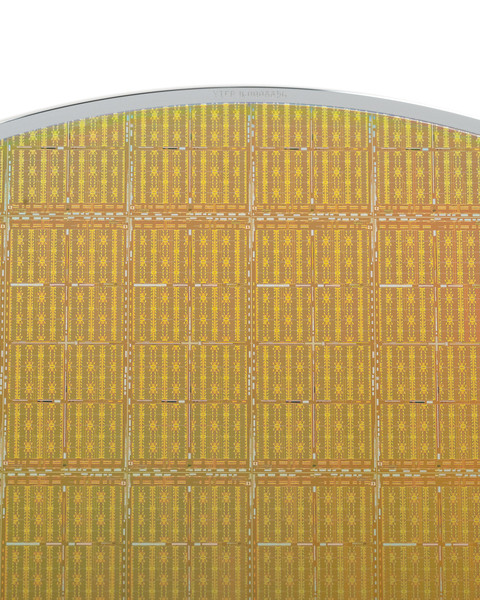
Now, MIT Lincoln Laboratory has developed a specialized chip to test and validate cooling solutions for packaged chip stacks. The chip dissipates extremely high power, mimicking high-performance logic chips, to generate heat through the silicon layer and in localized hot spots. Then, as cooling technologies are applied to the packaged stack, the chip measures temperature changes. When sandwiched in a stack, the chip will allow researchers to study how heat moves through stack layers and benchmark progress in keeping them cool.
Complete article from MIT News.
Explore
Graphene can hold multiple states of superconductivity, a new study finds
Jennifer Chu | MIT News
What’s more, the superconducting states get stronger under conditions expected to kill them.
Improving the reliability of circuits for quantum computers
Adam Zewe | MIT News
A new technique helps scientists measure a phenomenon that can cause quantum circuits to perform differently than expected, increasing the error in computations.
Powerful shrinking technique could enable devices that compute with light
Anne Trafton | MIT News
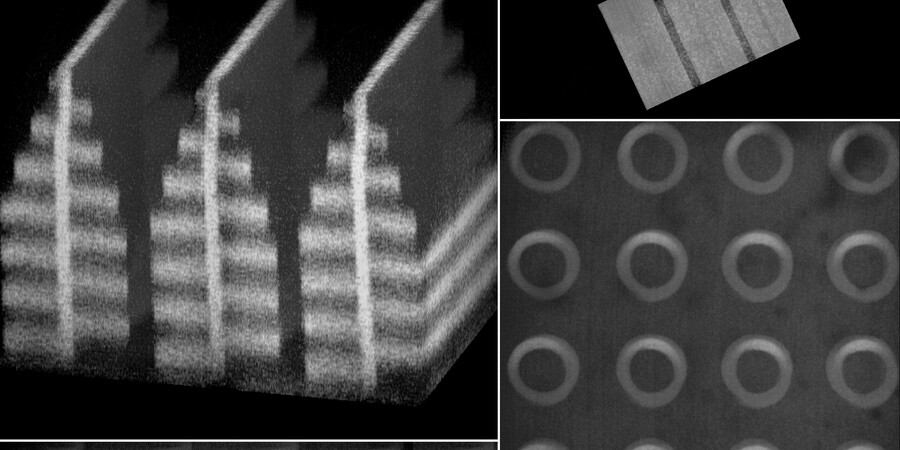
MIT researchers created tiny 3D photonic devices with features small enough to channel visible light.


