

The AMD Instinct MI300 Series, encompassing the MI300X and MI300A models, represents a pioneering integration of high-performance computing (HPC) and artificial intelligence (AI) capabilities within a single package, leveraging advanced silicon and packaging technologies. Designed for both CPU-hosted PCIe devices (MI300X) and self-hosted accelerated processing units (APUs) (MI300A), these accelerators utilize AMD’s chiplet architecture and advanced packaging to combine data center class CPU, GPU compute, AMD Infinity Cache, and an 8-stack HBM3 memory system, aiming to deliver over 5TBps of peak bandwidth. The MI300X targets large model AI training and inference in traditional server setups, while the MI300A is optimized for high-density HPC systems, facilitating seamless pointer sharing between CPU and GPU kernels. This new series not only extends the hybrid bonding technology for enhanced performance and efficiency but also introduces spatial partitioning and advanced memory side caching techniques, significantly advancing AMD’s capabilities in the AI and HPC domains.
This event is part of the Joint MIT AI Hardware Program and Microsystems Technology Laboratories Seminar Series.

Speaker
Alan Smith
Alan Smith is an AMD Sr. Fellow and leads the Instinct silicon architecture team, focusing on GPU accelerators for datacenters. His work involves developing System in Package solutions and architectures aimed at enhancing AI and HPC systems’ efficiency, especially under power constraints. Alan’s expertise extends to network-on-chip and memory architecture, with a keen interest in advancing 2.5D and 3D packaging to optimize performance and cost. He is a Senior Member of IEEE and holds MS ECE and BS EE degrees from Georgia Tech.
Explore

Graphene can hold multiple states of superconductivity, a new study finds
Jennifer Chu | MIT News
What’s more, the superconducting states get stronger under conditions expected to kill them.

Improving the reliability of circuits for quantum computers
Adam Zewe | MIT News
A new technique helps scientists measure a phenomenon that can cause quantum circuits to perform differently than expected, increasing the error in computations.
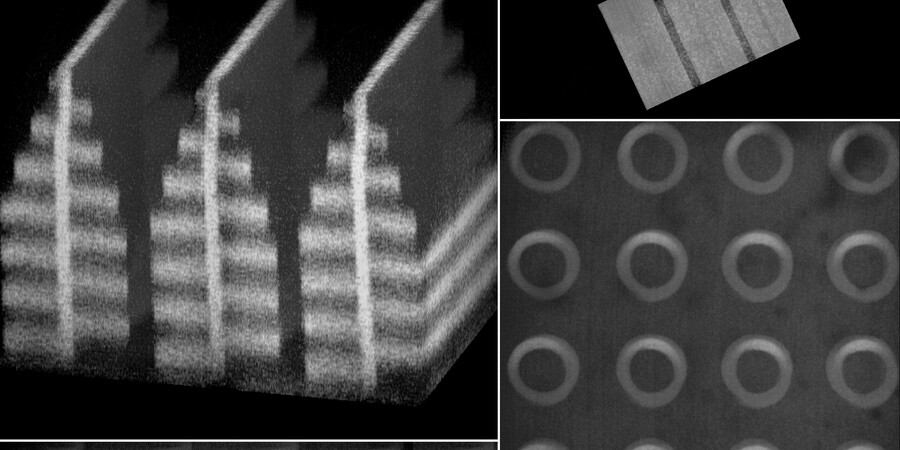
Powerful shrinking technique could enable devices that compute with light
Anne Trafton | MIT News
MIT researchers created tiny 3D photonic devices with features small enough to channel visible light.