


MIT AI Hardware Program Features NCB Research on 2D Neuromorphic Devices for Sustainable Artificial Intelligence
Mark Grinstein-Camacho | MIT Media Lab
Nano Cybernetic Biotrek develops technologies to understand brains and employ these insights to build brainlike computers.

MIT to Name Building 12, Home of MIT.nano, in Honor of Lisa Su
MIT Resource Development
Building 12, the home of MIT.nano, will soon be named in honor of Lisa T. Su ’90, SM ’91, PhD ’94, chief executive officer and chair of the Board of Directors of AMD. Su is the first MIT alumna to make a gift for a building that will bear her own name.

Dan Huttenlocher Ponders Our Human Future in an Age of Artificial Intelligence
Adam Zewe | MIT News Office
For the MIT Schwarzman College of Computing dean, bringing disciplines together is the best way to address challenges and opportunities posed by rapid advancements in computing.
MIT AI Hardware Program Inaugural Symposium
Friday, May 6, 2022 | 9:30am - 3:00pm ET
Multiple Speakers
MIT, Amazon, TSMC, ASML and Friends to Work on Non-planet-killing AI hardware
Katyanna Quach | The Register
Big names in tech are collaborating with academics to develop energy-optimized machine-learning and quantum-computing systems under the MIT AI Hardware Program.
Workshop Tackles a Critical Gap Slowing the Development of New Hardware Technologies
Amanda Stoll DiCristofaro | MIT.nano
MIT, RPI, and SUNY convene a national conversation on semiconductor tech translation and hard-tech startups.
NTT Research Joins MIT AI Hardware Program
NTT Research
NTT Research, Inc., a subsidiary of NTT, today announced that it has joined the Massachusetts Institute of Technology (MIT) Artificial Intelligence (AI) Hardware Program as an inaugural industrial member.
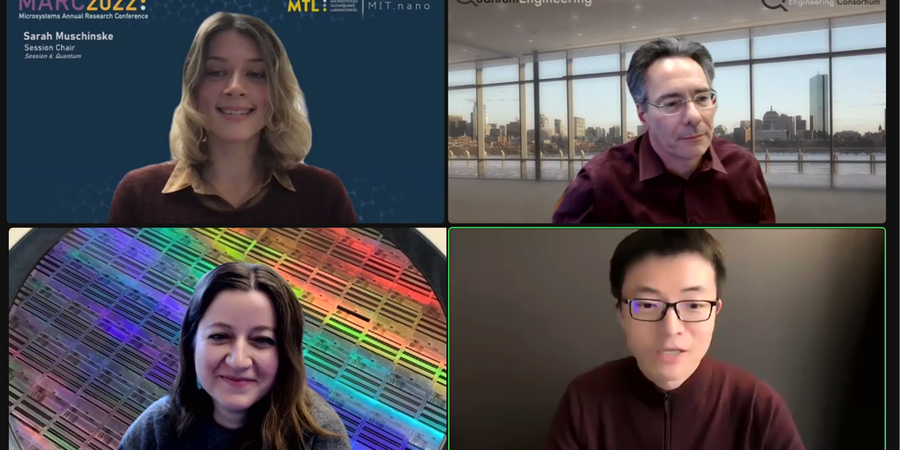
Last-minute Pivot Leads to Record-setting Microsystems Annual Research Conference
Amanda Stoll DiCristofaro | MIT.nano
Virtual conference gathered students, faculty, and industry partners to explore the future of microsystems and nanotechnology.

Toward Batteries that Pack Twice as Much Energy Per Pound
David L. Chandler | MIT News Office
In the endless quest to pack more energy into batteries without increasing their weight or volume, one especially promising technology is the solid-state battery.